Executive Summary
SEBI's Department of Economic and Policy Analysis (DEPA) released two studies on 20 August 2026 via Press Release No. 50/2026: "Profitability of Individual Traders in the Equity Derivatives Segment (FY25–FY26)" and "Trading Behaviour of Individual Traders in the Equity Derivatives Segment (FY25–FY26)."
Correction to earlier draft: the studies were published on 20 August 2026 (not a generic "August 2026"), and the earlier draft carried no findings — it is the findings that give the update its regulatory significance.
Background
SEBI has periodically studied retail participation and outcomes in equity derivatives given persistent policy concern about retail losses. The FY25–FY26 studies follow SEBI's earlier F&O loss studies (2023, 2024).
What Has Changed?
SEBI published updated profitability and behaviour data for individual traders in the Equity Derivatives Segment (EDS) for FY 2025–26, based on client-level data covering roughly 90% of individual traders (profitability study) and a random sample of 5,000 traders (behaviour study).
Key Provisions / Findings
- Active individual traders fell ~20%, from 98.1 lakh (FY25) to 78.6 lakh (FY26); new entrants fell ~40%.
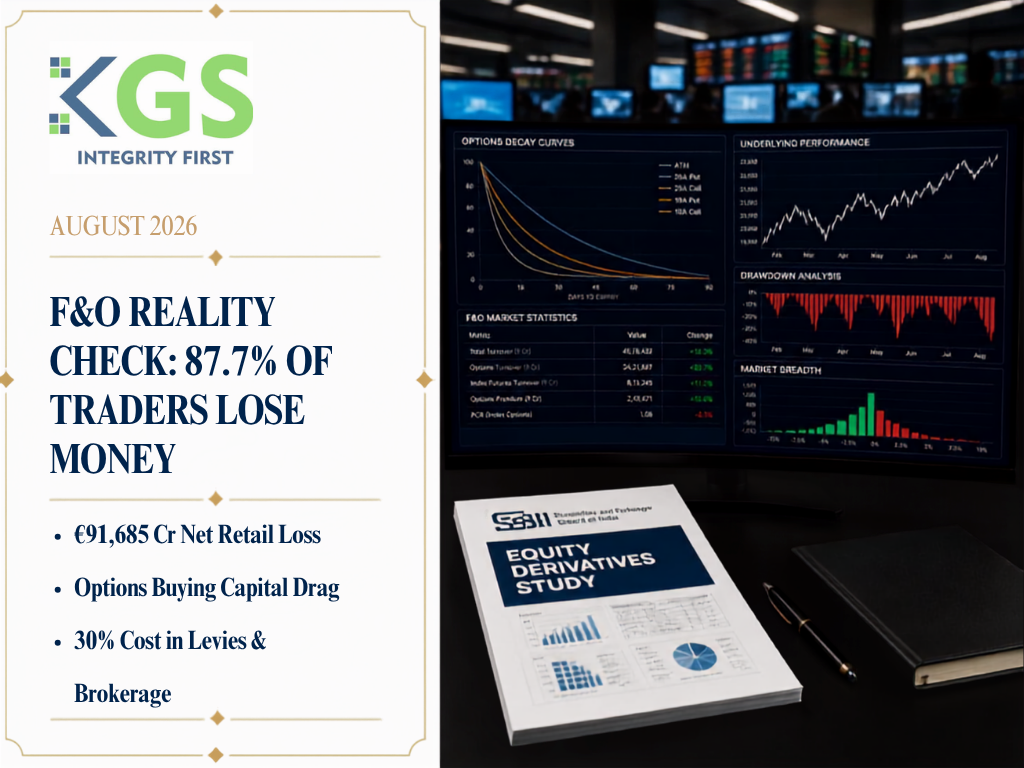
- Aggregate net losses of individual traders declined to ~?91,685 crore in FY26, from ~?1.12 lakh crore in FY25.
- Despite the decline in aggregate losses, 87.7% of individual traders still incurred net losses in FY26.
- Average loss per trader rose marginally to ~?1.17 lakh.
- ~92% of aggregate losses arose from options trading; ~97% of traders predominantly followed options-buying strategies.
Applicability / Who Are Affected
Individual F&O traders, stockbrokers and trading platforms, market intermediaries, investor-education initiatives, and policymakers.
Practical Implication
The data reinforces the continuing risk profile of retail options trading even as participation moderates, relevant to intermediaries' investor-risk disclosures and awareness programmes.
What Businesses Should Do
- Review the findings relevant to client segments.
- Strengthen investor-risk disclosures, particularly on options trading.
- Monitor trading-pattern and risk indicators among retail clients.
- Factor the findings into investor-protection and suitability discussions.
KGS Perspective
The persistence of a ~88% loss rate despite falling participation numbers suggests risk communication, not just participation limits, remains the key lever. Entities in the securities ecosystem should treat this as ongoing evidentiary support for stronger investor-risk messaging around options trading specifically.
Conclusion
SEBI's FY26 studies confirm that while retail F&O participation and aggregate losses have declined, the proportion of individual traders losing money remains high, concentrated overwhelmingly in options trading.
Source / Regulatory Reference
- SEBI – Study on Profitability of Individual Traders in Equity Derivatives (FY25–FY26): https://www.sebi.gov.in/reports-and-statistics/research/aug-2026/study-profitability-of-individual-traders-in-the-equity-derivatives-segment-fy25-fy26-_103835.html
- SEBI – Study on Trading Behaviour of Individual Traders in Equity Derivatives (FY25–FY26): https://www.sebi.gov.in/reports-and-statistics/research/aug-2026/study-trading-behaviour-of-individual-traders-in-the-equity-derivatives-segment-fy25-fy26-_103836.html
- SEBI – Press Release No. 50/2026 (20 August 2026): https://www.sebi.gov.in/media-and-notifications/press-releases/aug-2026/sebi-studies-indicate-key-trends-in-retail-participation-trading-behaviour-and-profitability-in-the-equity-derivatives_103838.html

Comments
No Comments yet