SEBI Revises Merchant Banker Due Diligence Requirements for AIF Private Placement Memorandum (PPM)
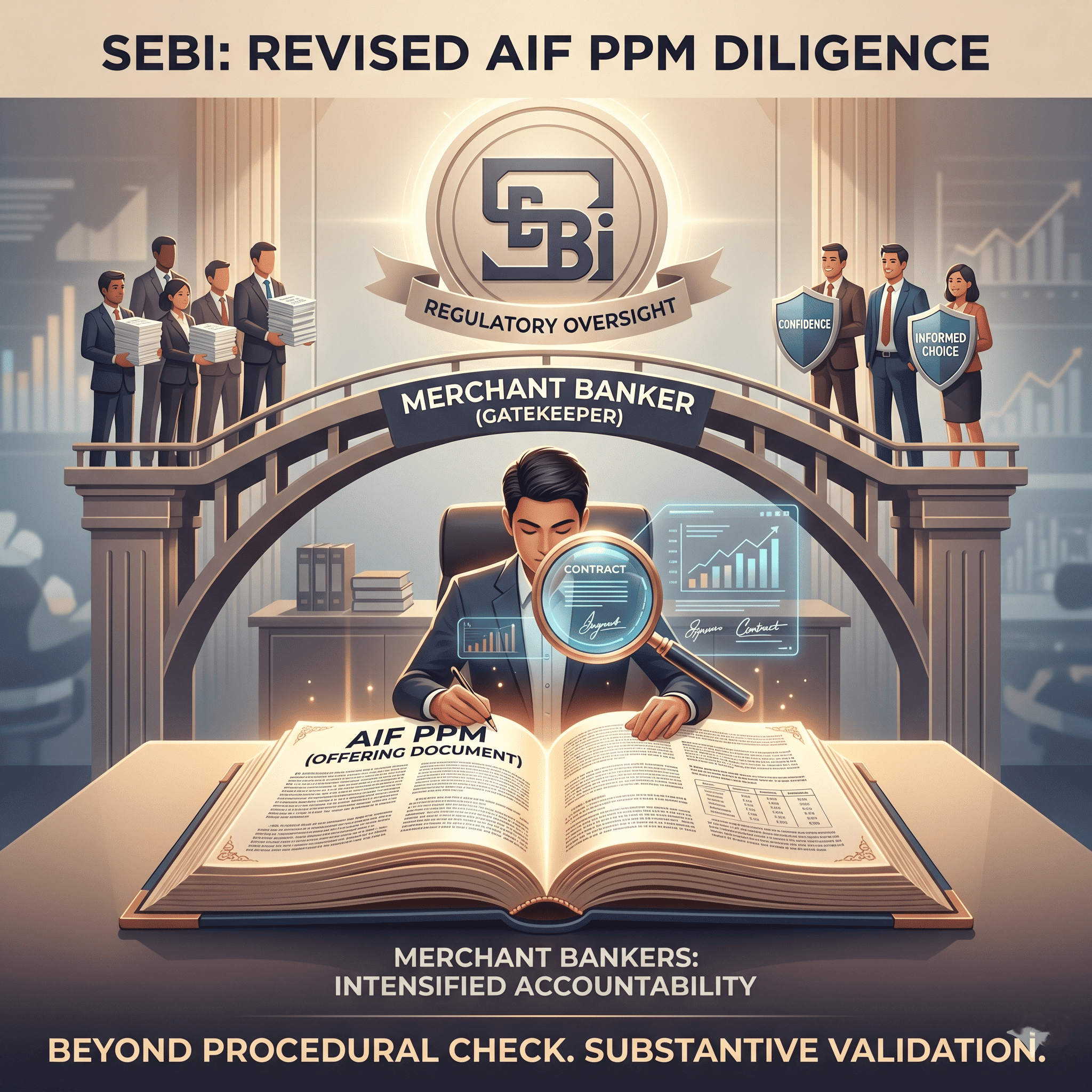
The Securities and Exchange Board of India (SEBI) has issued a significant circular introducing revised due diligence and disclosure responsibilities for Merchant Bankers associated with Alternative Investment Funds (AIFs). The circular primarily focuses on strengthening accountability, improving disclosure quality, and enhancing investor protection in relation to Private Placement Memorandums (PPMs).
This move reflects SEBI’s continued emphasis on transparency, governance, and accuracy of information being presented to investors in the alternative investment ecosystem.
Background of the Amendment
Under the existing AIF framework, the Private Placement Memorandum (PPM) serves as the principal offering document through which investors evaluate an AIF scheme before investing. Over time, SEBI observed the need for stronger validation and accountability mechanisms regarding disclosures made in these documents.
To address this concern, SEBI has now expanded the role and responsibility of Merchant Bankers involved in filing and certifying PPMs, especially for non-LVF (Large Value Fund for Accredited Investors) schemes.
The circular also amends provisions of the SEBI Master Circular for AIFs dated May 07, 2024.
What Has Changed?
1. Enhanced Due Diligence Responsibility of Merchant Bankers
SEBI has clarified that Merchant Bankers undertaking due diligence of PPMs must independently verify the disclosures made by the AIF and its Manager.
This effectively increases the level of professional scrutiny expected before submission of the PPM to SEBI.
The due diligence process is no longer intended to be a procedural review alone; instead, it requires substantive validation of material disclosures, claims, and statements.
2. Mandatory Due Diligence Certificate
A revised due diligence certificate format has been prescribed.
The Merchant Banker is now required to certify that:
- The disclosures in the PPM are true, fair, and adequate.
- The information enables investors to make informed investment decisions.
- The disclosures comply with SEBI (AIF) Regulations, 2012 and related circulars.
- Necessary verification and examination procedures have been carried out.
This substantially raises professional accountability for intermediaries involved in the process.
3. Clear Disclaimer Regarding SEBI Approval
The circular specifically reiterates that submission of a PPM to SEBI should not be interpreted as approval or endorsement by SEBI.
SEBI has clarified that it does not assume responsibility for:
- Accuracy of disclosures
- Claims made in the PPM
- Capability or performance of the Manager
The responsibility remains entirely with the AIF Manager and Merchant Banker.
This clarification is particularly important from an investor communication and legal risk perspective.
Increased Accountability for Errors or Misstatements
One of the most important aspects of the circular is the explicit provision stating that any irregularity, lapse, or misleading disclosure in the PPM may attract regulatory action against the concerned entities.
This includes accountability of:
- AIF Managers
- Merchant Bankers
- Other responsible parties involved in preparation and certification
The amendment therefore shifts the compliance expectation from “document submission” to “document reliability.”
Applicability of the Circular
The circular comes into force immediately and also applies to:
- All pending PPMs of non-LVF schemes currently under SEBI review.
This means even ongoing filings may need reassessment to align with the revised due diligence expectations.
Practical Impact on AIF Industry Participants
For AIF Managers
AIF Managers will now need to maintain:
- Stronger documentation support
- Robust internal validation processes
- Accurate representation of risks and investment strategy
- Better coordination with legal and compliance teams
Managers may also face longer preparation timelines due to deeper verification requirements.
For Merchant Bankers
The role of Merchant Bankers has become substantially more sensitive and risk-oriented.
They may now need to:
- Conduct deeper factual verification
- Maintain proper due diligence working papers
- Increase scrutiny over financial, legal, and operational disclosures
- Strengthen review mechanisms before certification
This could also lead to enhanced professional liability exposure.
For Investors
From an investor protection standpoint, the amendment is a positive development.
The revised framework aims to:
- Improve reliability of disclosures
- Reduce information asymmetry
- Enhance confidence in AIF investment documents
- Promote informed investment decision-making
Professional Perspective
This circular reflects SEBI’s broader regulatory approach toward increasing gatekeeper accountability within the financial ecosystem.
Rather than relying solely on regulatory review, SEBI is placing greater responsibility on intermediaries and professionals involved in preparation and validation of disclosures.
The amendment also aligns with global regulatory trends where due diligence obligations of financial intermediaries are becoming increasingly stringent.
For professionals working in investment funds, compliance, merchant banking, legal advisory, and internal audit functions, this update reinforces the importance of documentation integrity, disclosure governance, and evidence-backed certifications.
Conclusion
SEBI’s revised due diligence framework for AIF PPMs is a significant compliance development for the alternative investment industry.
The circular strengthens:
- Transparency
- Disclosure quality
- Professional accountability
- Investor protection mechanisms
While the enhanced responsibilities may increase compliance effort for Managers and Merchant Bankers, the overall framework is expected to improve market discipline and confidence within the AIF ecosystem.
Going forward, regulated entities will need to adopt a far more rigorous and evidence-driven approach while preparing and certifying PPM disclosures.

Comments
No Comments yet