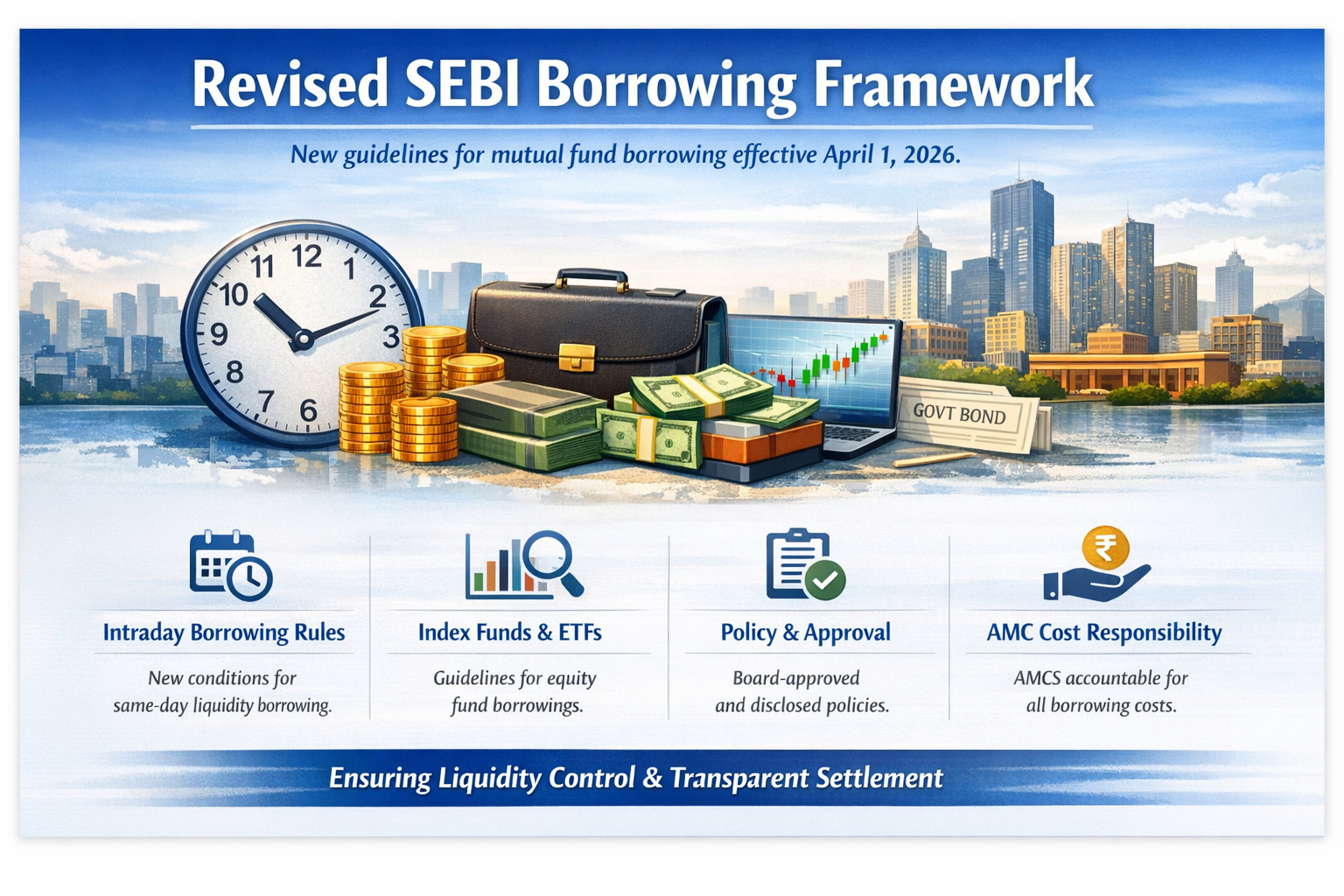
SEBI Releases Updated Borrowing Guidelines for Mutual Funds: Effective April 1, 2026
The Securities and Exchange Board of India (SEBI) has issued a comprehensive circular revising the framework for borrowing by mutual funds. These updates, set to take effect on April 1, 2026, bring structured operational clarity to intraday borrowing practices and define specific provisions for borrowing by equity-oriented index funds and exchange-traded funds (ETFs). The changes are intended to enhance liquidity management and strengthen investor safeguards.
1. Background and Rationale
Liquid and overnight mutual fund schemes often face timing mismatches in cash flow:
- Redemption payments to investors are typically processed in the morning of T+1.
- Inflows from TREPS, reverse repo, and government securities usually reach the scheme later in the day.
To manage this gap, mutual funds routinely rely on intraday borrowing arrangements—an industry practice now formalized under the SEBI (Mutual Funds) Regulations, 2026. Regulation 42 permits mutual funds to borrow under defined limits, while clarifying that intraday borrowing does not fall within the standard 20% borrowing cap. SEBI’s latest circular outlines how such borrowing must be managed going forward.
2. Intraday Borrowing: Updated Conditions
Effective April 1, 2026, the following conditions will govern the use of intraday borrowing by mutual funds:
2.1 Policy Approval and Disclosure
Asset Management Companies must:
- Formally document their intraday borrowing policy.
- Obtain approval from both the AMC Board and the Board of Trustees.
- Publish the approved policy on the AMC’s website for public access.
2.2 Permissible Use
Intraday borrowing may be undertaken solely for:
- Repurchase or redemption of units.
- Payment of interest.
- Income Distribution cum Capital Withdrawal (IDCW) payouts.
No other operational or investment purpose is permitted.
2.3 Borrowing Limit Tied to Confirmed Receivables
Borrowing cannot exceed guaranteed same day receivables from:
- Maturity proceeds of TREPS.
- Proceeds from reverse repo.
- Maturity proceeds of G Secs, Treasury Bills, State Development Loans, STRIPS.
- Interest on government securities.
- Same day sale proceeds of G Secs, T bills, SDLs, or STRIPS.
This structure ensures that intraday borrowing remains fully covered by confirmed inflows.
2.4 AMC Responsibility for Costs
Consistent with SEBI’s Master Circular, any cost associated with intraday borrowing must be borne by the AMC.
Additionally, if delays or unforeseen events result in losses, the AMC—not the scheme or its investors—must absorb the impact.
3. Borrowing by Equity Index Funds and ETFs
SEBI has announced the introduction of the Closing Auction Session in the equity cash segment, applicable from August 3, 2026.
In alignment with this development:
- Equity-oriented index funds and ETFs may borrow funds only to manage settlement requirements arising from under execution of sell trades in this specific session.
- This borrowing flexibility is restricted exclusively to supporting participation in the closing auction and must follow the framework detailed in the January 16, 2026 SEBI circular.
This ensures accurate index replication and smooth settlement without exposing schemes to undue borrowing risks.
4. Implications for Asset Management Companies
The revised framework brings several operational and governance implications for AMCs:
4.1 Strengthened Liquidity Management
The revised guidelines streamline same-day liquidity operations for liquid and overnight schemes, reducing operational friction during redemption cycles.
4.2 Enhanced Transparency and Governance
Mandatory board approval and public disclosure of borrowing policies reinforce accountability and improve investor confidence.
4.3 Clear Risk Allocation
By mandating that AMCs bear all borrowing-related costs and losses, SEBI ensures that unit holders remain insulated from operational risks.
4.4 Better NAV Accuracy for Index Funds
Permitting borrowing for closing auction participation enables more precise execution for index-linked products.
SEBI’s updated borrowing framework introduces structured, principle based rules designed to align industry practices with formal regulatory standards. By defining explicit conditions, strengthening oversight, and protecting investors from operational risk, the circular marks a significant step toward more resilient liquidity management across the mutual fund ecosystem.

Comments
No Comments yet