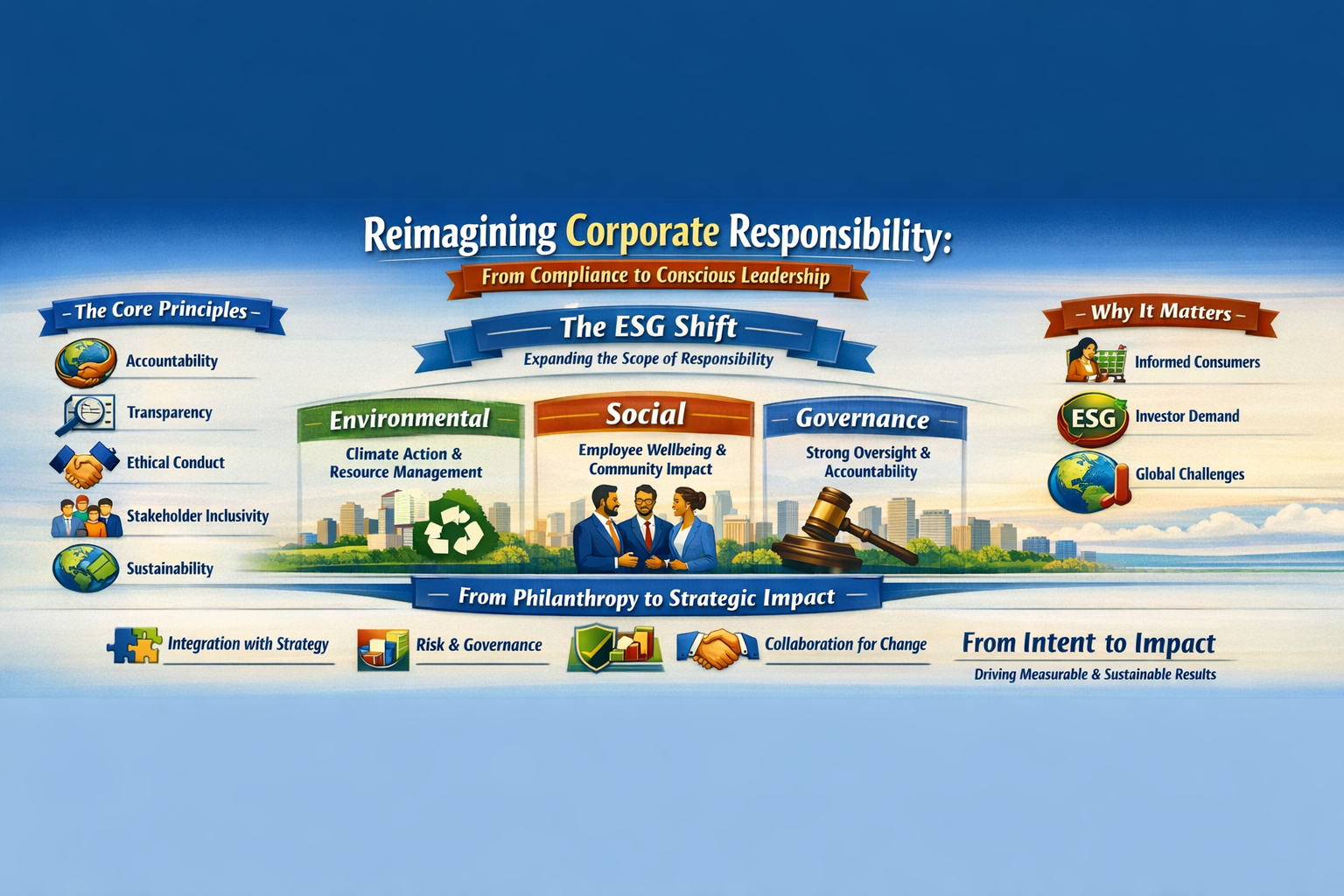
Reimagining Corporate Responsibility: From Compliance to Conscious Leadership
In today’s rapidly evolving business landscape, corporate responsibility is no longer a peripheral function—it is central to how organizations create value, build trust, and sustain growth. What was once seen as philanthropy or compliance has now transformed into a strategic imperative that influences decision-making at every level.
As businesses navigate increasing stakeholder expectations, regulatory pressures, and global challenges, understanding the deeper principles of corporate responsibility becomes essential.
The Foundation: Core Principles That Drive Responsible Business
At its core, corporate responsibility is about integrating ethical, social, and environmental considerations into everyday business operations. While frameworks may evolve, the foundational principles remain consistent:
1. Accountability
Organizations must take ownership of their actions and their broader impact—financial, social, and environmental. This includes being answerable not only to shareholders but to society at large.
2. Transparency
Clear, honest, and timely disclosure of information fosters trust. Whether it’s sustainability reporting or governance practices, transparency strengthens credibility.
3. Ethical Conduct
Operating with integrity is non-negotiable. Ethical decision-making ensures fairness, reduces risk, and builds long-term relationships.
4. Stakeholder Inclusivity
Modern businesses must recognize and respect the interests of all stakeholders—employees, communities, customers, investors, and partners.
5. Sustainability Orientation
Long-term thinking is key. Businesses must ensure that their operations do not compromise environmental balance or future generations’ needs.
These principles are not abstract—they serve as actionable pillars that guide organizations toward responsible growth.
Why Corporate Responsibility Is a Strategic Necessity
The relevance of corporate responsibility has grown significantly in recent years. This shift is driven by multiple factors:
- Informed consumers demanding ethical and sustainable products
- Investors prioritizing ESG-aligned companies
- Regulatory frameworks becoming more stringent
- Global challenges like climate change and inequality
Organizations that embed responsibility into their core strategy often experience:
- Stronger brand reputation
- Higher employee engagement
- Better risk management
- Improved long-term financial performance
Conversely, ignoring these aspects can lead to reputational damage, regulatory penalties, and loss of stakeholder trust.
The ESG Shift: Expanding the Scope of Responsibility
While Corporate Social Responsibility (CSR) has traditionally focused on community development and philanthropy, ESG (Environmental, Social, and Governance) has significantly expanded the scope.
ESG introduces a structured, measurable, and investor-driven lens to responsibility by integrating:
- Environmental factors – Climate change, resource efficiency, waste management
- Social factors – Employee wellbeing, diversity, community impact, human rights
- Governance factors – Board structure, ethics, compliance, risk management
Unlike traditional CSR, which often operates as a separate function, ESG is embedded into core business strategy, risk assessment, and financial decision-making.
This marks a fundamental shift—from “doing good” to “doing responsible business.”
How ESG is Reshaping the CSR Landscape
The rise of ESG is not replacing CSR—it is redefining and strengthening it. The relationship between the two is becoming increasingly interconnected, with ESG acting as a broader framework within which CSR operates.
1. From Philanthropy to Measurable Impact
CSR initiatives are now expected to demonstrate quantifiable outcomes. ESG frameworks push organizations to move beyond activity-based reporting to impact-based measurement.
For example:
- Instead of reporting the number of trees planted, companies now measure carbon sequestration impact
- Instead of counting beneficiaries, they assess long-term socio-economic outcomes
2. Strategic Alignment with Business Goals
CSR is no longer a standalone department—it is being aligned with business strategy and ESG priorities.
Organizations are increasingly:
- Linking CSR initiatives with climate goals, supply chain sustainability, and SDGs
- Designing projects that contribute to both community development and business resilience
This ensures that CSR investments are not just compliant, but strategically relevant.
3. Increased Focus on Governance and Accountability
ESG brings governance into sharper focus, which directly impacts CSR execution.
Key changes include:
- Stronger board oversight on CSR and sustainability initiatives
- Improved due diligence of NGO partners and implementation agencies
- Enhanced audit, monitoring, and reporting mechanisms
This shift is particularly relevant in the Indian context, where regulatory frameworks are evolving to demand greater transparency.
4. Integration with Risk Management
CSR is increasingly being viewed through a risk and opportunity lens.
ESG helps organizations identify:
- Environmental risks (e.g., climate disruptions)
- Social risks (e.g., community conflicts, labor issues)
- Reputational risks
CSR initiatives are now designed to mitigate these risks while creating shared value.
5. Data-Driven Decision Making
One of the most significant transformations ESG brings is the use of data and metrics.
CSR programs are now:
- Backed by baseline assessments and impact evaluations
- Monitored through KPIs and ESG indicators
- Integrated into annual sustainability and BRSR reports
This data-driven approach enhances both credibility and effectiveness.
The Indian Context: Convergence of CSR and ESG
India presents a unique landscape where mandatory CSR under the Companies Act, 2013 intersects with emerging ESG regulations such as BRSR (Business Responsibility and Sustainability Reporting).
This convergence is leading to:
- Greater alignment between CSR spending and ESG disclosures
- Increased emphasis on long-term sustainability outcomes
- Higher expectations from corporates in terms of impact, transparency, and governance
Organizations are now expected to go beyond compliance and demonstrate how their CSR initiatives contribute to national and global sustainability goals.
From Intent to Impact: The Way Forward
As ESG continues to evolve, the future of CSR will be defined by:
- Integration – CSR embedded within ESG and business strategy
- Innovation – Use of technology for impact measurement and reporting
- Collaboration – Partnerships between corporates, NGOs, and governments
- Accountability – Stronger governance and transparent disclosures
The organizations that succeed will be those that can seamlessly connect purpose with performance.
Conclusion
Corporate responsibility is undergoing a profound transformation. ESG is not just a new framework—it is a catalyst that is reshaping how CSR is designed, implemented, and evaluated.
As highlighted in the broader understanding of corporate responsibility principles , the journey requires a shift in mindset—from isolated initiatives to integrated strategies.
For organizations, the message is clear:
The future belongs to those who can translate responsibility into measurable, meaningful, and sustainable impact

Comments
No Comments yet