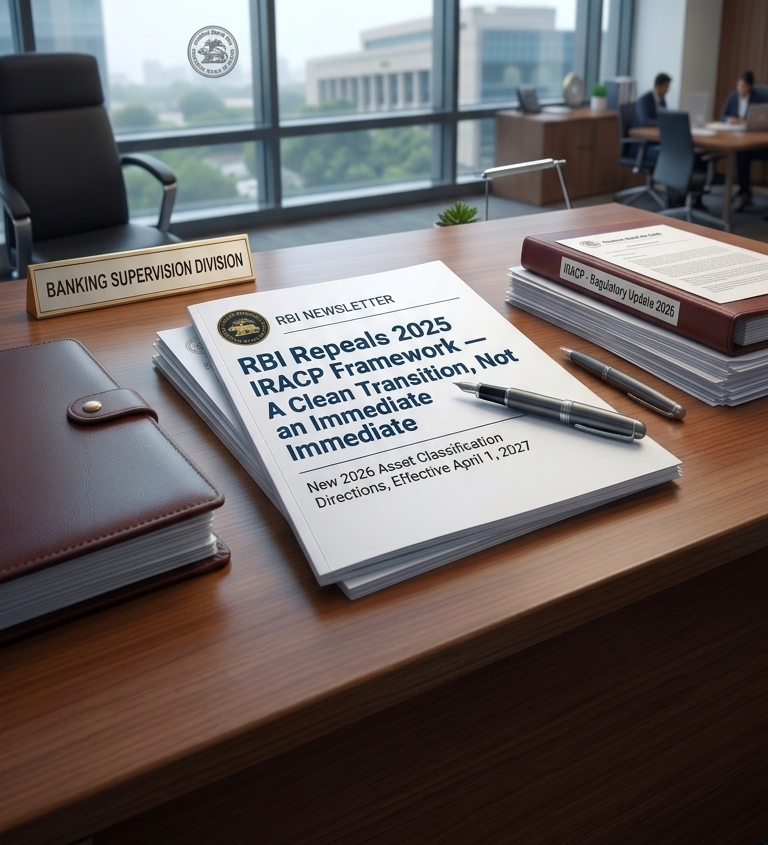
The Reserve Bank of India has issued the IRACP Repeal Directions, 2026, formally replacing the 2025 framework governing income recognition, asset classification, and provisioning for commercial banks. While the announcement may appear technical, its implications are precise and important—it restructures the regulatory base without altering current compliance requirements.
What Has Actually Changed
1. Complete Repeal and Replacement of the 2025 Directions
The existing IRACP Directions, 2025 will cease to operate and will be replaced by a fresh, consolidated IRACP framework (2026).
What this really changes:
The regulatory foundation is being reset into a new base document, likely aimed at improving clarity, removing layered amendments, and creating a more streamlined framework going forward.
2. Deferred Implementation — Effective from April 1, 2027
The repeal and the new Directions will come into force from April 1, 2027, not immediately.
What this means in practice:
- Banks will continue following the 2025 norms for the entire FY 2026–27
- There is a clear transition window to prepare for the new framework
- No immediate impact on provisioning, NPA classification, or income recognition
3. Explicit Protection of Past Actions and Liabilities
The Directions clearly state that repeal will not affect anything already done under the earlier framework, including:
- Rights, obligations, and liabilities already created
- Any penalties or enforcement actions for past non-compliance
- Ongoing or future legal proceedings linked to earlier events
What this changes:
There is no escape from past compliance exposure. The repeal does not dilute accountability—it preserves it.
4. Continuity of Approvals and Regulatory Actions
Any approvals, acknowledgements, or actions taken under the 2025 Directions will be treated as valid under the new regime.
Practical impact:
- Banks are not required to reapply or revalidate past approvals
- Ensures operational continuity without duplication or disruption
What Has Not Changed
- There is no immediate revision in IRACP norms
- Existing rules for NPA classification, provisioning, and income recognition remain fully applicable
- Financial reporting and audit approaches do not change at present
Why This Matters
At a structural level, this move achieves three things:
Regulatory Clarity:
By replacing the earlier framework with a new base document, RBI is likely aiming to reduce interpretational complexity created by multiple amendments over time.
Legal Continuity:
The detailed savings clause ensures there is no ambiguity around past actions, which is critical from a litigation and enforcement perspective.
Planned Transition:
By deferring applicability to April 2027, RBI is giving institutions time to align systems, policies, and internal controls in a structured manner.
Practical Implications for Professionals
For Chartered Accountants & Auditors
- Continue applying existing IRACP norms without modification
- Ensure documentation of past classifications and provisioning decisions is robust, as these remain enforceable
For Compliance Functions
- No immediate overhaul required, but transition planning should begin early
- Closely evaluate the upcoming 2026 Directions once fully analysed
For Banking & Finance Teams
- Maintain focus on current compliance discipline
- Use the transition window to strengthen internal frameworks and data systems
Closing Perspective
This is not a change in how banks classify assets or recognise income—yet.
It is a change in how the regulatory framework itself is structured and transitioned.
The underlying message is clear:
Regulations may be rewritten, but continuity of compliance and accountability remains non-negotiable.
For professionals, the real opportunity lies in using this transition period not just to adapt—but to build stronger, more resilient compliance systems before the new framework takes effect.

Comments
No Comments yet