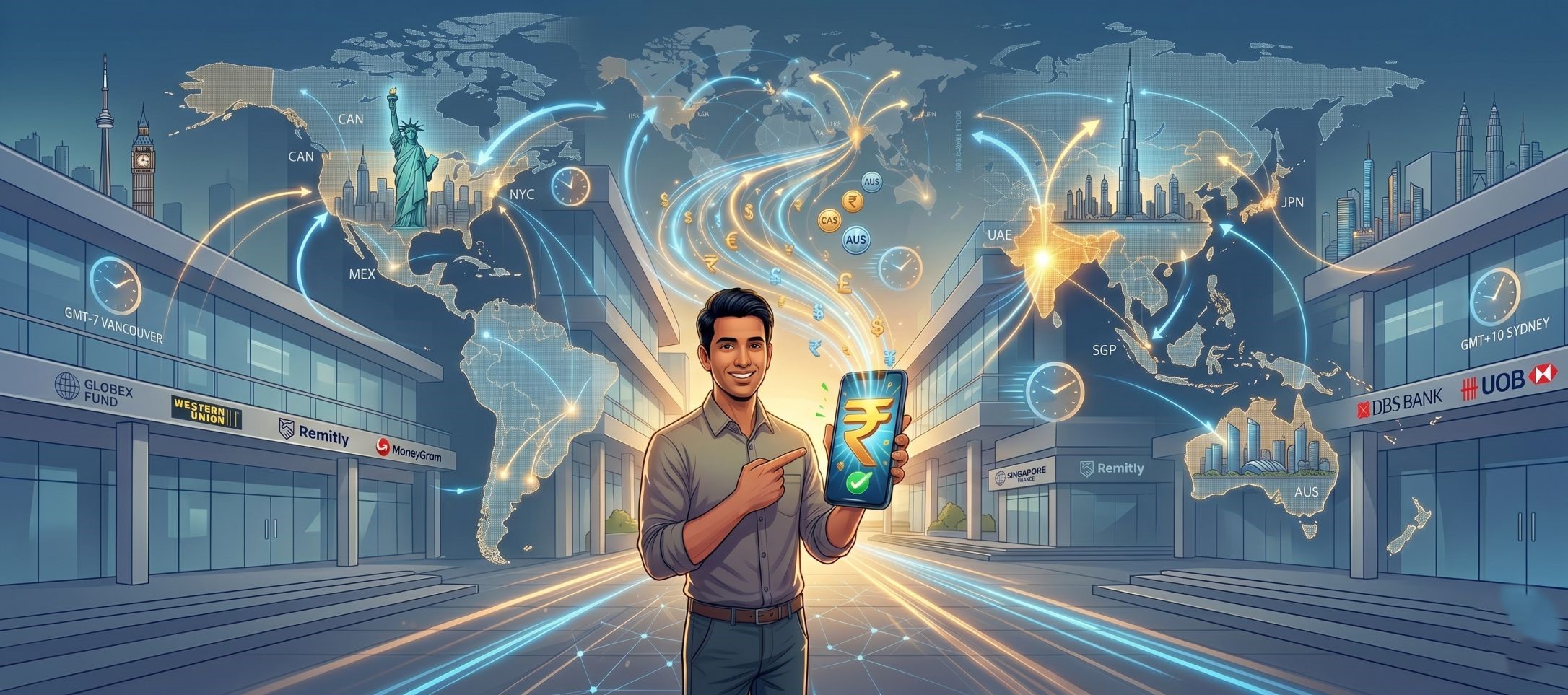
The Shift You Can’t Ignore
Cross-border payments have long been a friction point in global finance—slow credits, opaque timelines, and heavy manual intervention.
With its latest guidelines, the Reserve Bank of India (RBI) has targeted a specific bottleneck: delays at the beneficiary bank stage. This is not a broad policy overhaul—it is a process-level intervention with direct operational consequences.
What Has Actually Changed?
The update introduces clear, time-bound expectations for banks at the final leg of inward remittances:
1. Immediate Customer Intimation
Banks are now required to notify customers as soon as an inward payment message is received. If received after banking hours, intimation must happen at the start of the next business day.
What’s new?
Earlier, customer visibility was often delayed until internal confirmation processes were completed. Now, information flow is decoupled from credit processing.
2. Near Real-Time Nostro Reconciliation
Banks traditionally relied on end-of-day nostro account statements, leading to delays in confirming funds.
The RBI now mandates:
- Frequent reconciliation (near real-time or periodic)
- Maximum interval: 1 hour
What’s changed?
This effectively eliminates batch-based reconciliation and pushes banks toward continuous monitoring systems.
3. Same-Day Credit Expectation
Banks are expected to:
- Credit funds received during forex market hours on the same day
- Credit after-hours receipts on the next business day
What’s new?
This introduces a clear service-level expectation, replacing loosely defined timelines.
4. Straight-Through Processing (STP) for Individuals
Banks are now encouraged to:
- Implement automated credit (STP) for individual resident accounts
- Subject to risk assessment and FEMA compliance
What’s changed?
A shift from manual verification-heavy workflows to automation-led processing.
5. Digital Interface for Customers
Banks are expected to:
- Provide digital platforms for forex transactions
- Enable document submission and transaction tracking
What’s new?
This formalizes the move toward end-to-end digital customer journeys in cross-border flows.
Why This Matters
1. The Real Bottleneck Was Domestic, Not Global
Global payment systems have improved significantly, but delays persisted at the last mile—within domestic banks.
This circular directly addresses that gap.
2. Aligning with Global Standards
The move aligns with the G20 roadmap targeting:
- Faster payments
- Greater transparency
- Lower friction
India is moving closer to globally benchmarked payment efficiency.
3. Liquidity and Cash Flow Impact
For businesses, especially exporters and service providers:
- Faster credit means better working capital cycles
- Reduced uncertainty improves cash flow planning
Practical Implications for Stakeholders
For Banks
- Upgrade reconciliation systems to near real-time capability
- Re-engineer internal workflows to meet same-day credit expectations
- Invest in automation (STP) and digital interfaces
- Strengthen compliance checks without slowing processing
For Businesses & Professionals
- Expect faster visibility and access to inbound funds
- Reduced dependency on follow-ups with banks
- Improved treasury planning and liquidity forecasting
For Compliance & Audit Professionals
- Evaluate whether banks have:
- Implemented hourly reconciliation controls
- Established clear audit trails for credit timelines
- Ensured FEMA compliance within accelerated processes
- Increased focus on system controls over manual checks
The Bigger Signal
This is not just about speed—it is about redefining operational accountability.
RBI is moving from:
- Process flexibility → Time-bound discipline
- Manual verification → System-driven assurance
- Customer uncertainty → Transparency and predictability
Effective Timeline
Banks have been given a 6-month implementation window, signaling that:
- This is a serious operational mandate, not a directional advisory
- Systems, not just policies, need to change
Closing Perspective
The real transformation in payments does not happen at the global network level—it happens at the last mile of execution.
By tightening timelines, enforcing real-time reconciliation, and encouraging automation, RBI has addressed a long-standing inefficiency in cross-border inward payments.
For institutions, this is a technology and process challenge.
For businesses, it is a liquidity advantage.
And for the ecosystem, it marks a clear shift: Speed, transparency, and control are no longer aspirations—they are regulatory expectations.

Comments
No Comments yet