Executive Summary
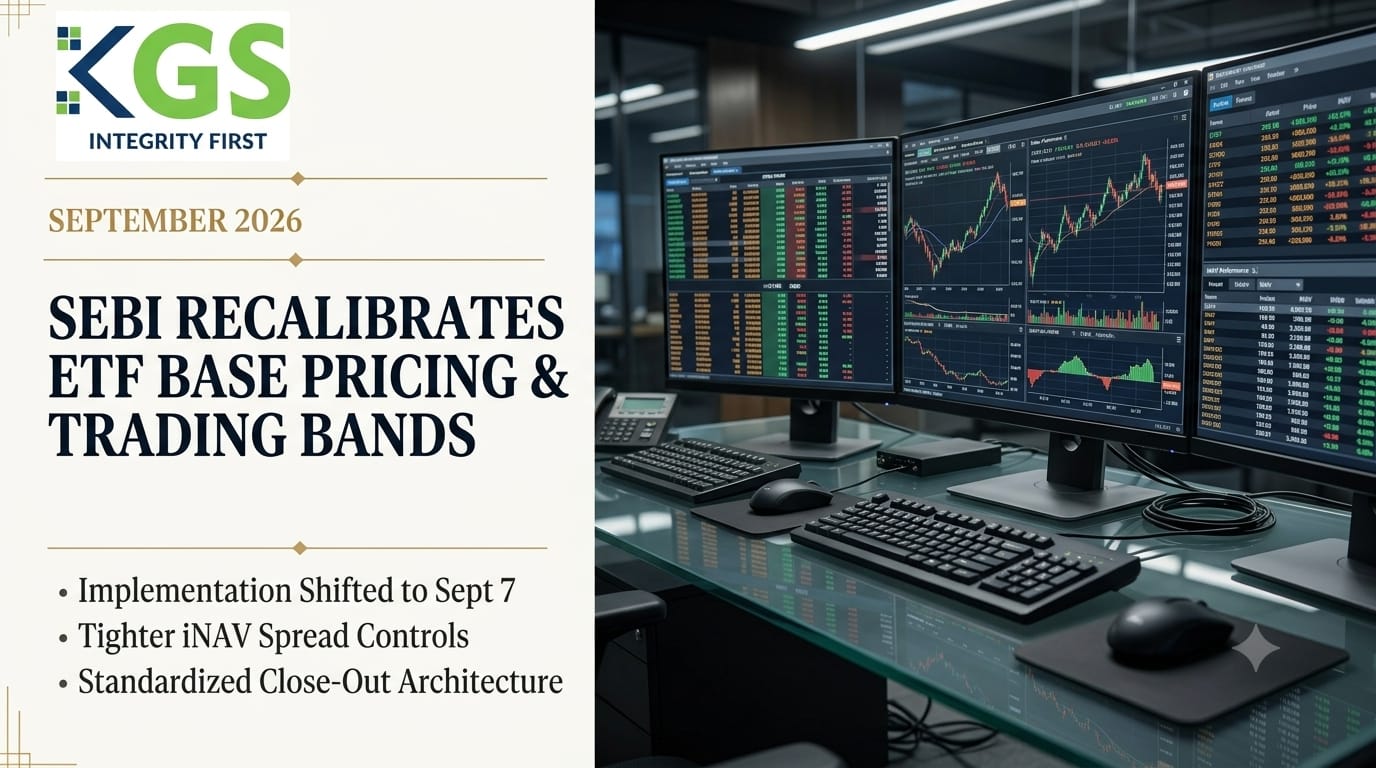
The Securities and Exchange Board of India (SEBI) extended the effective implementation date of its operational circular governing Exchange Traded Funds (ETFs) from September 1, 2026, to September 7, 2026. The underlying framework redesigns base price calculation methodologies, daily price bands, pre-open sessions, and close-out procedures for ETF units traded on stock exchanges. The short extension allowed exchanges and clearing corporations to conduct final market-wide mock trading sessions.
Background
ETFs have become core investment vehicles for institutional and retail investors. However, intraday liquidity mismatches, sudden tracking errors, and extreme volatility during opening sessions led to distorted pricing far removed from intrinsic Net Asset Value (NAV). In June 2026, SEBI introduced a comprehensive operational architecture to tether ETF trading bounds closer to indicative NAV (iNAV), mandating market infrastructure adjustments.
What Has Changed
Particulars Earlier Position (June 2026 Circular) Revised Position (August Circular)
Effective Implementation Date September 1, 2026 September 7, 2026
Trading System Cutover Initial scheduled launch Completed post final market-wide mock testing
Key Provisions
• Base Price Calibration: Modifies how the base price of ETF units is set for continuous trading, incorporating recent iNAV or closing volume-weighted averages.
• Dynamic Price Bands: Establishes standardized cooling-off intervals and dynamic band flexings to curb irrational algorithmic price spikes.
• Close-Out Norms: Standardizes clearing corporation settlement obligations and close-out mark-ups for failed trades in ETF units.
Applicability
• Covered Entities: Recognized Stock Exchanges (BSE, NSE), Clearing Corporations, Asset Management Companies (AMCs) managing ETF schemes, and authorized market makers.
• Securities Covered: All listed equity, debt, commodity, and currency ETF units.
Practical Implications
• Risk Management: Market makers and algorithmic trading desks must reconfigure trading bands and quoting limits to avoid technical rejections.
• Exchange Infrastructure: Exchanges ensured stable deployment through mock trades, avoiding real-time execution halts in ETF books.
• Investor Protection: Tighter tracking bounds protect retail participants from executing market orders at arbitrary premium or discount spreads.
What Should We Do
• Update quantitative trading engines, algorithms, and limit systems to mirror the revised price band matrices.
• Review liquidity provider and market-maker agreements to verify obligations under revised continuous quotation rules.
• Ensure middle-office systems track real-time iNAV feeds from AMCs to detect tracking errors immediately.
KGS Perspective
Structural integrity in secondary market ETF trading is essential for market depth and capital protection. Market infrastructure entities and trading firms must maintain disciplined change management protocols whenever price-band and settlement logic undergo regulatory revision.
Conclusion
SEBI’s deferral to September 7, 2026, ensured smooth operational readiness for the overhauled ETF trading and price-band architecture, establishing fairer pricing mechanisms across secondary markets.
Source / Regulatory Reference
• Regulator: Securities and Exchange Board of India (SEBI)
• Notification / Circular / Regulatory Reference: SEBI Circular on ETF Trading Norms [Dated 28 August 2026 / Effective 07 September 2026]
• Official Document Link: https://www.sebi.gov.in

Comments
No Comments yet