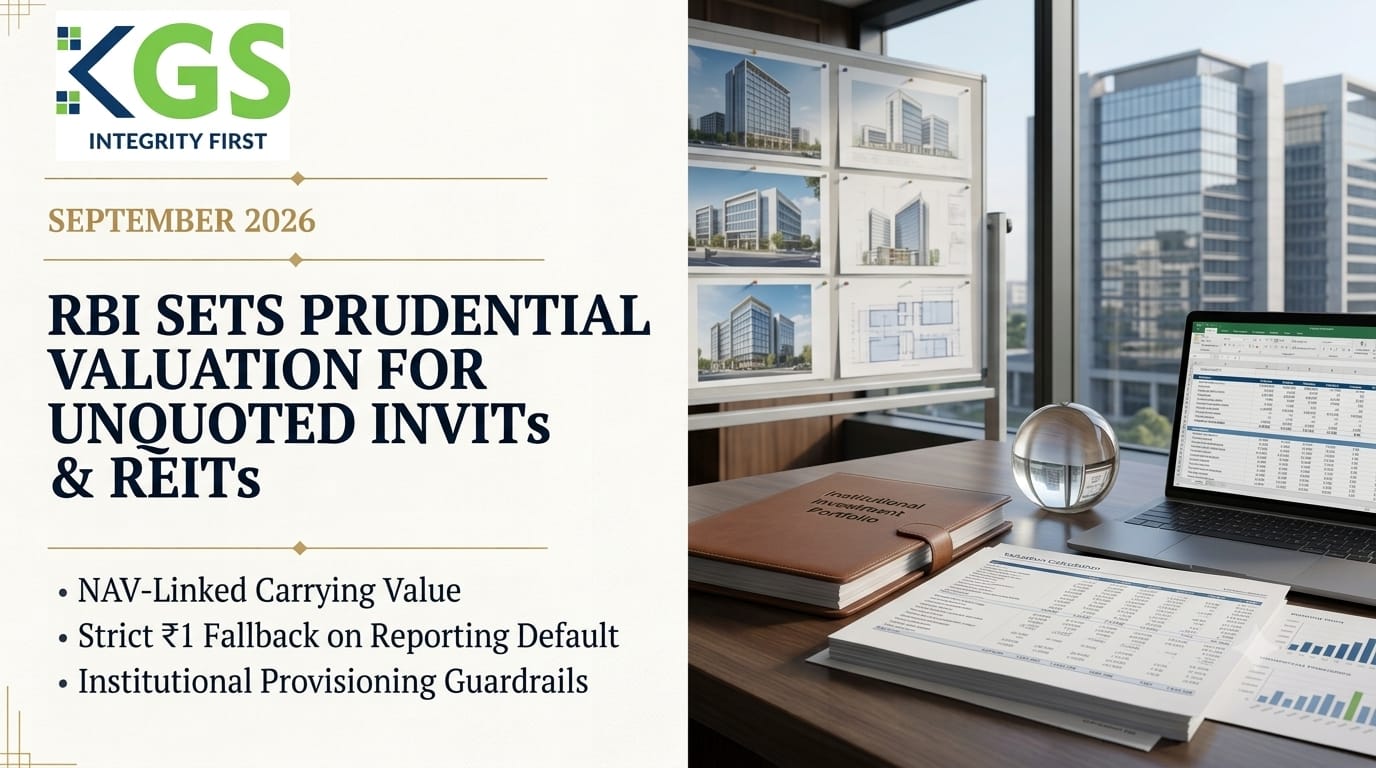
Executive Summary
In September 2026, the RBI issued circular instructions standardizing the prudential valuation methodology for investments held by banks and financial institutions in unquoted units of Infrastructure Investment Trusts (InvITs) and Real Estate Investment Trusts (REITs). The guidelines mandate valuation at declared Net Asset Value (NAV), establishing a nominal ?1 per trust fallback where timely NAV disclosures are absent.
Background
Commercial banks and financial institutions have increasingly participated in alternative infrastructure and real estate financing instruments, including unlisted or privately placed InvITs and REITs. Due to the lack of secondary market pricing, institutions applied varying internal valuation techniques, creating balance sheet discrepancies. The RBI intervened to establish consistent, transparent asset valuation rules.
What Has Changed
Particulars Earlier Practice New Standardized Norm (RBI Sep 2026)
Valuation Baseline Varied internal cost-to-NAV models Latest declared NAV by the Investment Manager
Absence of Timely NAV Discretionary carrying values or historical cost Mandatory markdown to ?1 per trust
Key Provisions
• Primary Valuation Rule: Unquoted InvIT and REIT units must be valued based on the latest available NAV published by the trust's investment manager, which must not be older than the statutory reporting interval.
• Default Penalty Valuation: If an InvIT or REIT fails to declare its NAV within statutory or prescribed timelines, the carrying value across the regulated entity's books must be reduced to ?1.
• Provisioning & Impairment: Any drop in valuation relative to historical acquisition cost must be recognized in the Profit & Loss statement as an impairment loss.
Applicability
• Covered Entities: All Scheduled Commercial Banks, All-India Financial Institutions (NABARD, NHB, EXIM Bank, SIDBI), and Primary Dealers.
Practical Implications
• Financial Reporting: Regulated entities must track periodic disclosures from unlisted trust managers to avoid severe book markdowns.
• Investment Agreements: Covenants in private placements must mandate strict disclosure deadlines for investment managers to protect carrying values.
• Audit Scrutiny: Statutory auditors will examine NAV reporting timelines and mandate the ?1 markdown where compliance defaults occur.
What Should We Do
• Conduct an inventory of all unquoted InvIT and REIT units across investment portfolios.
• Establish automated alerts tracking the publication dates of independent valuation reports and NAV declarations.
• Amend future trust participation agreements to incorporate indemnification clauses against reporting defaults.
• Review quarterly valuation markdowns and ensure adjustments flow through current-period financial results.
KGS Perspective
Prudential valuation norms reinforce market discipline in alternative investment structures. Regulated investors must maintain strict compliance oversight, ensuring investment managers deliver timely audited valuations to protect institutional capital.
Conclusion
The RBI's definitive valuation framework eliminates subjectivity in accounting for unquoted InvITs and REITs, establishing clear penalties for delayed asset reporting.
Source / Regulatory Reference
• Regulator: Reserve Bank of India (RBI)
• Notification / Circular / Regulatory Reference: RBI Prudential Directions on Valuation of Unquoted InvITs and REITs [Issued September 2026]
• Official Document Link: https://www.rbi.org.in

Comments
No Comments yet