Executive Summary
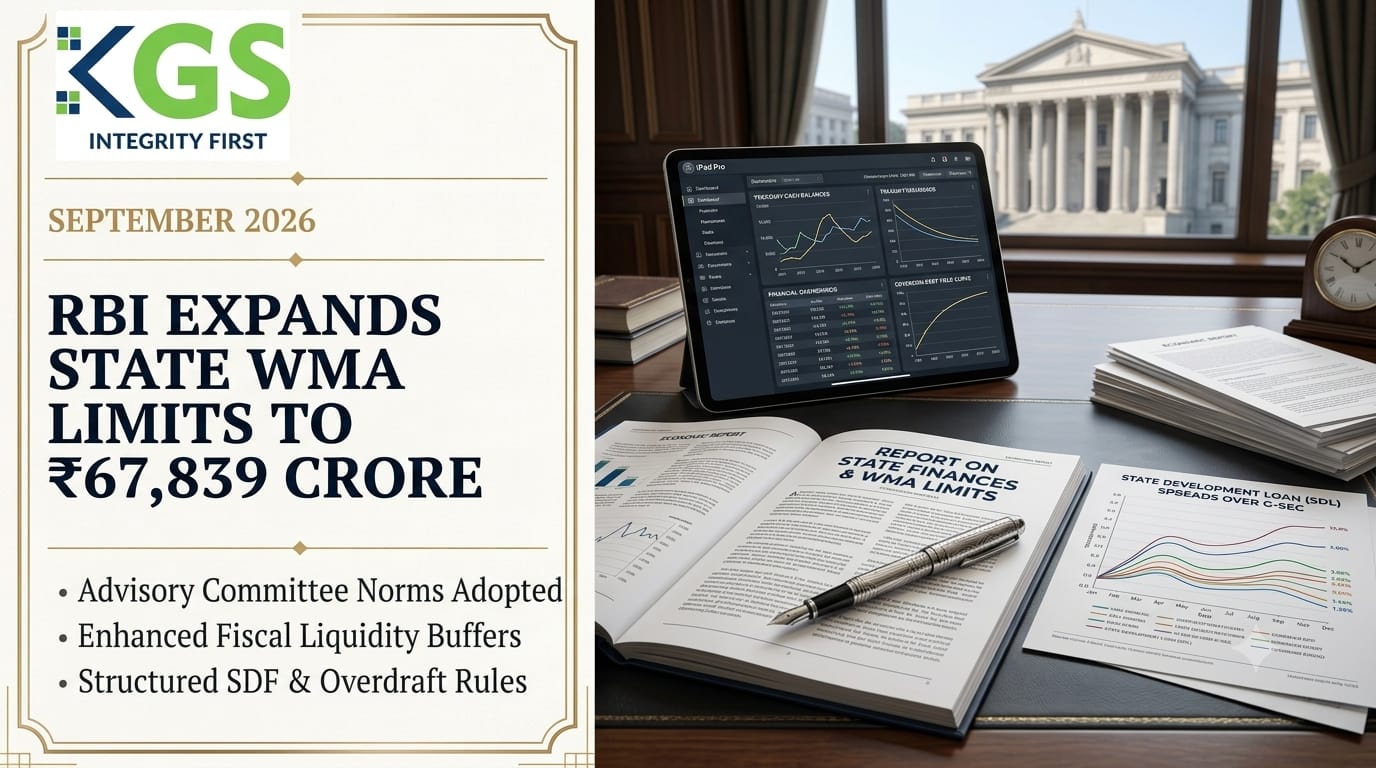
The Reserve Bank of India accepted the recommendations of the Advisory Committee on Ways and Means Advances (WMA) for State Governments and Union Territories. The revised framework raises the aggregate WMA limit for all States to ?67,839 crore. This recalibration expands liquidity facilities available to regional governments to manage temporary cash flow mismatches between revenue receipts and fiscal expenditures.
Background
Ways and Means Advances are short-term liquidity facilities extended by the RBI to central and state governments under Section 17(5) of the RBI Act, 1934. Limits are adjusted periodically to reflect changing expenditure bases, revenue collections, and economic developments. The Advisory Committee was constituted to examine revenue volatility and recommend appropriate prudential safety buffers.
What Has Changed
Particulars Earlier Framework Revised Framework (Committee Recommendations Accepted)
Total WMA Limit for States/UTs Previous ad-hoc limits ?67,839 Crore (Comprehensive Benchmark)
Overdraft (OD) Parameters Rigid operational cooling intervals Calibrated flexibility tied to revised revenue formulas
Key Provisions
• Revised Limit Allocation: Individual state WMA allocations are calculated using a formula weighted toward historical revenue expenditure and budget sizes.
• Special Drawing Facility (SDF): States must exhaust their zero-risk SDF (linked to their investments in central government securities) before accessing the costlier WMA window.
• Overdraft Regulations: Outlines strict operational rules governing maximum permissible days of overdraft (typically 14 consecutive days) and quarterly ceilings.
Applicability
• Covered Entities: All 28 State Governments and Union Territories with legislatures banking with the Reserve Bank of India.
Practical Implications
• Public Finance & Markets: Mitigates the risk of sudden liquidity squeezes in state treasuries, curbing abrupt spikes in State Development Loan (SDL) bond yields.
• Banking System Liquidity: Influences short-term money market balances, informing banks' institutional treasury desks on regional borrowing demands.
• Fiscal Governance: Enhances liquidity planning while maintaining guardrails against chronic structural deficits.
What Should We Do
• Treasury managers and institutional investors holding state bonds (SDLs) should evaluate the impact on regional issuance schedules.
• Track inter-bank call money and sovereign debt spreads for potential shifts linked to state liquidity demands.
KGS Perspective
Transparent liquidity frameworks for state finances support overall sovereign debt stability. Understanding WMA utilization patterns provides key insights into sub-national fiscal dynamics and money market conditions.
Conclusion
The upward revision of state WMA limits to ?67,839 crore provides a disciplined liquidity management tool, maintaining financial stability across Indian public finance.
Source / Regulatory Reference
• Regulator: Reserve Bank of India (RBI)
• Notification / Circular / Regulatory Reference: RBI Advisory Committee Report and Press Release on WMA Limits for States [Issued September 2026]
• Official Document Link: https://www.rbi.org.in

Comments
No Comments yet