Executive Summary
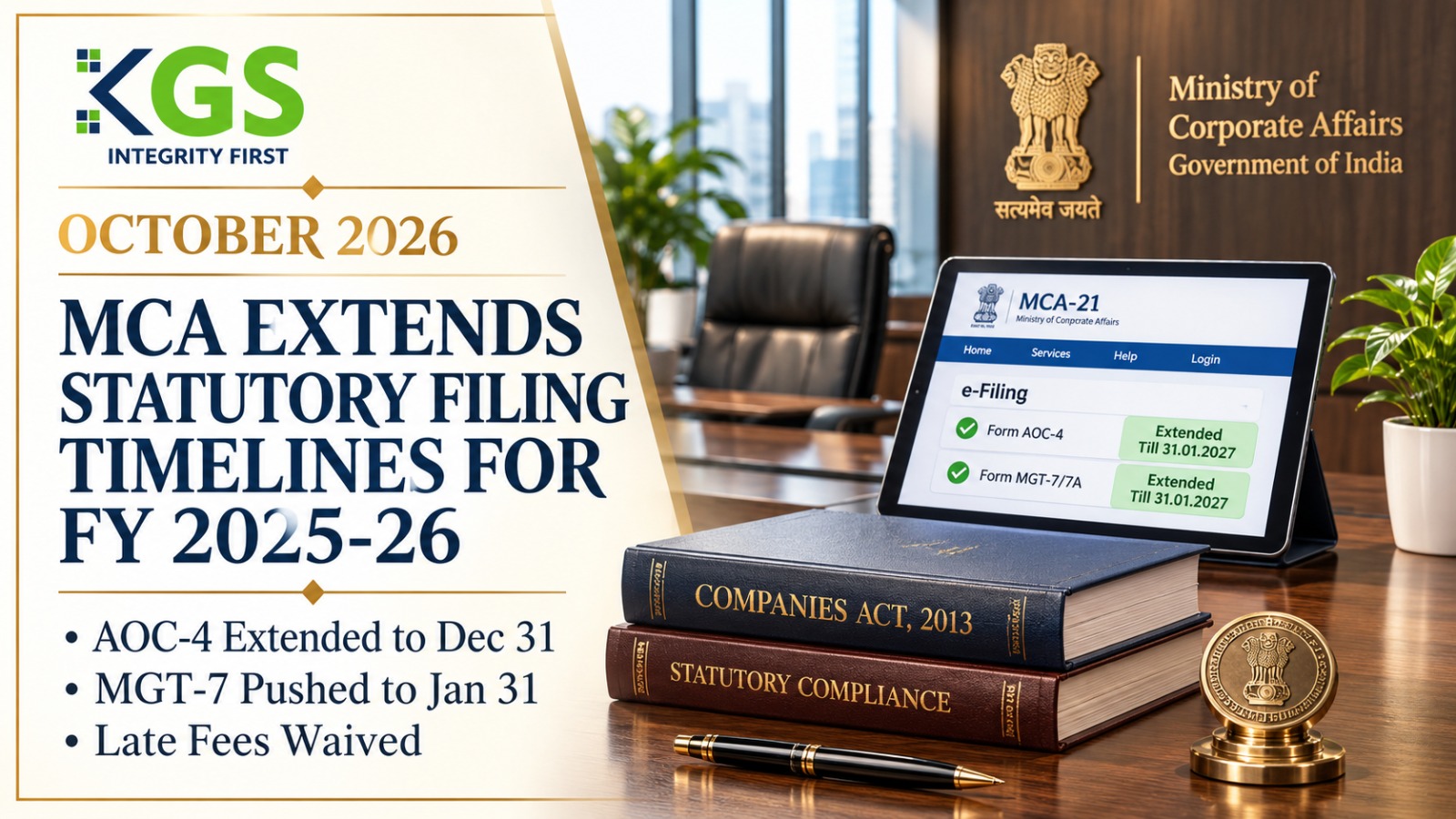
The Ministry of Corporate Affairs (MCA) has issued General Circular No. 05/2026, granting significant compliance relief by extending the due dates for filing annual statutory returns for the Financial Year 2025-26. The deadline for filing financial statements (Form AOC-4 series) is extended to December 31, 2026, and annual returns (Form MGT-7/7A) to January 31, 2027. This waiver of additional statutory fees provides vital breathing room for companies and professionals facing finalization delays.
Background
Every registered company must file audited financial statements within 30 days of its Annual General Meeting (AGM) and its annual return within 60 days. Failure triggers daily compounding additional fees. Recognizing portal capacity constraints and audit finalization challenges during the peak filing season, the MCA proactively granted a timeline extension to facilitate smoother corporate filings without penalizing companies.
What Has Changed
Particulars Standard Statutory Position Revised Position (General Circular 05/2026)
Form AOC-4 (Financial Statements) October 30, 2026 December 31, 2026
Form MGT-7 / 7A (Annual Return) November 29, 2026 January 31, 2027
Late Fees Accrues daily post-deadline Waived completely until revised dates
Key Provisions
• AOC-4 Series Extension: Companies can file Form AOC-4, AOC-4 CFS, AOC-4 XBRL, and AOC-4 NBFC for FY 2025-26 up to December 31, 2026, without additional statutory fees.
• MGT-7 Series Extension: The deadline to file Form MGT-7 and MGT-7A is extended to January 31, 2027, without additional fees.
• AGM Timelines Intact: The circular strictly waives the "additional fees" component for filing; it does not extend the statutory deadline for holding the AGM itself.
Applicability
• Covered Entities: All private, public, listed, and unlisted companies registered under the Companies Act, 2013, required to file annual documents for FY 2025-26.
• Covered Professionals: Company Secretaries, Chartered Accountants, and corporate directors acting as authorized signatories.
Practical Implications
• Finance & Audit: Audit teams gain essential operational bandwidth to close out audit working papers, finalize XBRL tagging, and complete board approvals.
• Cost Management: Eliminates the financial burden of compounding late fees that could otherwise accumulate rapidly.
• Portal Stability: By staggering the deadlines, the MCA reduces simultaneous server load, minimizing digital signature and payment gateway failures.
What Should We Do
1. Maintain AGM Timelines: Ensure the AGM is convened within the statutory timeframe or that a formal extension is obtained from the ROC.
2. Finalize Audit Reports: Utilize the extended window to thoroughly review financial disclosures and XBRL mappings for accuracy.
3. Execute Filings Early: Push completed forms through the MCA portal as soon as they are board-approved to avoid last-minute bottlenecks in December and January.
KGS Perspective
Statutory filing extensions relieve immediate pressure but can cause deferred compliance tasks to pile up. Corporate secretarial functions should treat the original deadlines as internal targets and use the MCA’s extension strictly as a buffer to ensure high-quality, error-free disclosures.
Conclusion
General Circular 05/2026 is a pragmatic intervention that safeguards companies from harsh financial penalties. Entities must strategically manage this timeline to ensure robust statutory reporting for FY 2025-26.
Regulatory Reference
• Regulator: Ministry of Corporate Affairs (MCA)
• Notification / Circular / Regulatory Reference: General Circular No. 05/2026 [Dated 24 October 2026]
• Official Document Link: https://www.mca.gov.in

Comments
No Comments yet