Executive Summary
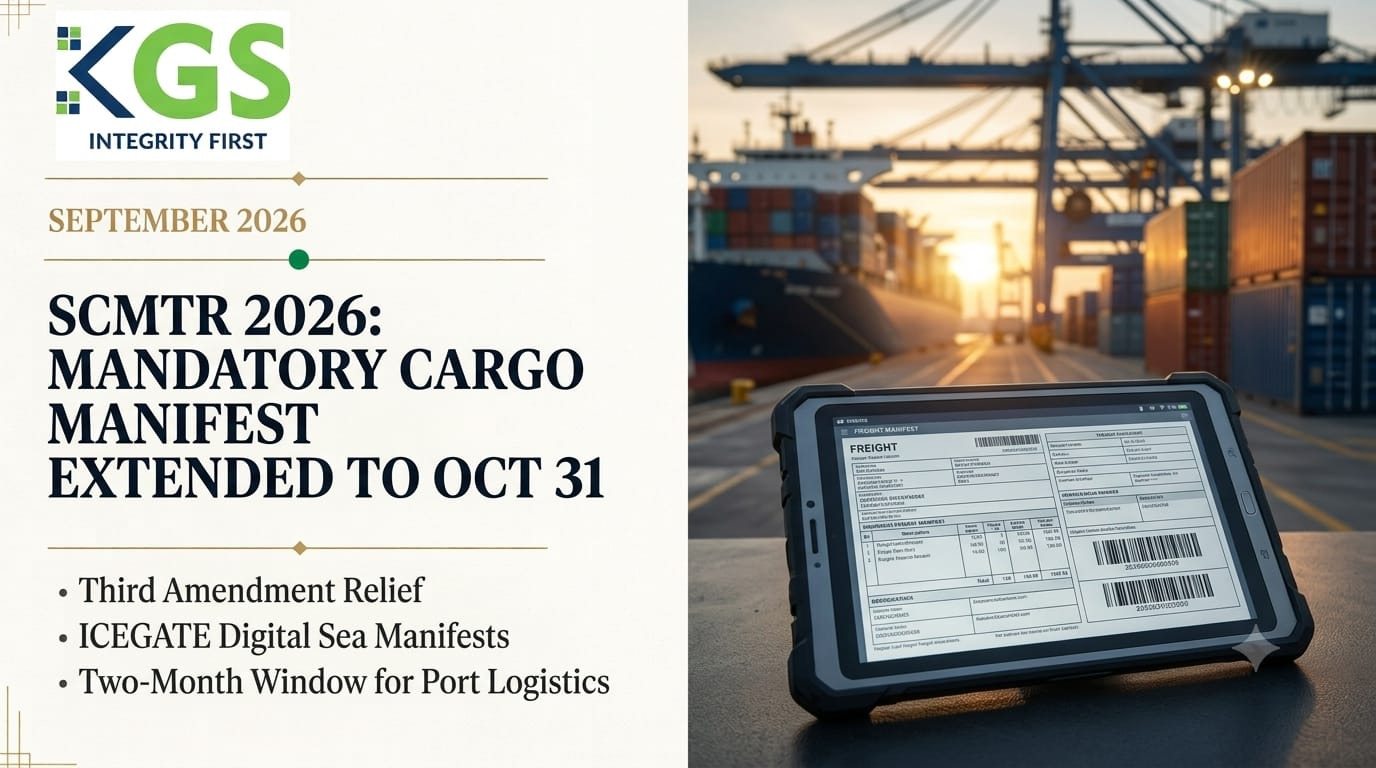
The Central Board of Indirect Taxes and Customs (CBIC) issued Notification No. 73/2026-Customs (N.T.), enacting the Sea Cargo Manifest and Transshipment (Third Amendment) Regulations, 2026. The notification extends the transitional implementation timeline for mandatory filing of electronic cargo manifests under the SCMTR framework to October 31, 2026. The extension allows maritime shipping lines, freight forwarders, and logistics operators to complete system integration with ICEGATE.
Background
The SCMTR, 2018, was introduced to replace legacy manifest procedures with a fully electronic, advance-manifest architecture. The system requires arrival manifests to be submitted prior to the vessel departure from the last port of call, and departure manifests before departure from Indian ports. Due to operational complexities across diverse shipping ecosystems, software interfaces, and terminal management systems, the CBIC has facilitated phased rollouts through transitional amendments.
What Has Changed
Particulars Earlier Position Revised Position (Notification No. 73/2026-Customs N.T.)
Transitional SCMTR Compliance Date August 31, 2026 October 31, 2026
Operational Manifest Mode Parallel testing under transitional window Final mandatory electronic cutoff post-October 31
Key Provisions
• Substituted Timelines: Substitutes the transition end-date following FORM-XII, establishing October 31, 2026, as the updated deadline.
• Reporting Formats: Enforces data submission formats for Sea Arrival Manifests (SAM) and Sea Departure Manifests (SDM).
• Authorized Sea Carriers (ASC): Mandates registration and digital certificate readiness for all maritime intermediaries engaging with port customs authorities.
Applicability
• Covered Entities: Shipping lines, main agents, non-vessel operating common carriers (NVOCCs), freight forwarders, customs brokers, and terminal operators handling maritime cargo.
• Transactions Covered: All import, export, and coastal transshipment cargo movements through notified Indian seaports.
Practical Implications
• Operations & Logistics: Supply chain entities receive two additional months to eliminate EDI errors and test API message exchanges with the ICEGATE system.
• Customs Compliance: Prevents vessel dwell times and vessel detention penalties that could arise from premature enforcement of rigid digital cargo rules.
• Internal IT Infrastructure: Freight forwarding companies must upgrade logistics ERPs to automate the generation of SCMTR-compliant XML/JSON message structures.
What Should We Do
• Conduct end-to-end integration tests between logistics management software and the ICEGATE SCMTR module.
• Ensure all trading partners, overseas loading agents, and domestic consignees provide standardized cargo descriptions.
• Monitor ASC and Authorized Operations registration statuses on customs portals.
• Review maritime contract clauses to clearly allocate liabilities for data-entry manifest errors post-October 31.
KGS Perspective
The modernized electronic manifest ecosystem under SCMTR shifts customs compliance upstream to origin departure points. Maritime and trade-oriented businesses must treat the extended window through October 31 as a final readiness phase, ensuring supply chain ERP data fields map seamlessly to customs checkpoints.
Conclusion
Notification No. 73/2026-Customs (N.T.) provides essential transitional breathing room for maritime logistics. Stakeholders must accelerate systems readiness to prevent supply chain disruptions once mandatory compliance takes effect.
Source / Regulatory Reference
• Regulator: Central Board of Indirect Taxes and Customs (CBIC)
• Notification / Circular / Regulatory Reference: Notification No. 73/2026-Customs (N.T.) [Dated 01 September 2026]
• Official Document Link: https://www.cbic.gov.in

Comments
No Comments yet