Introduction
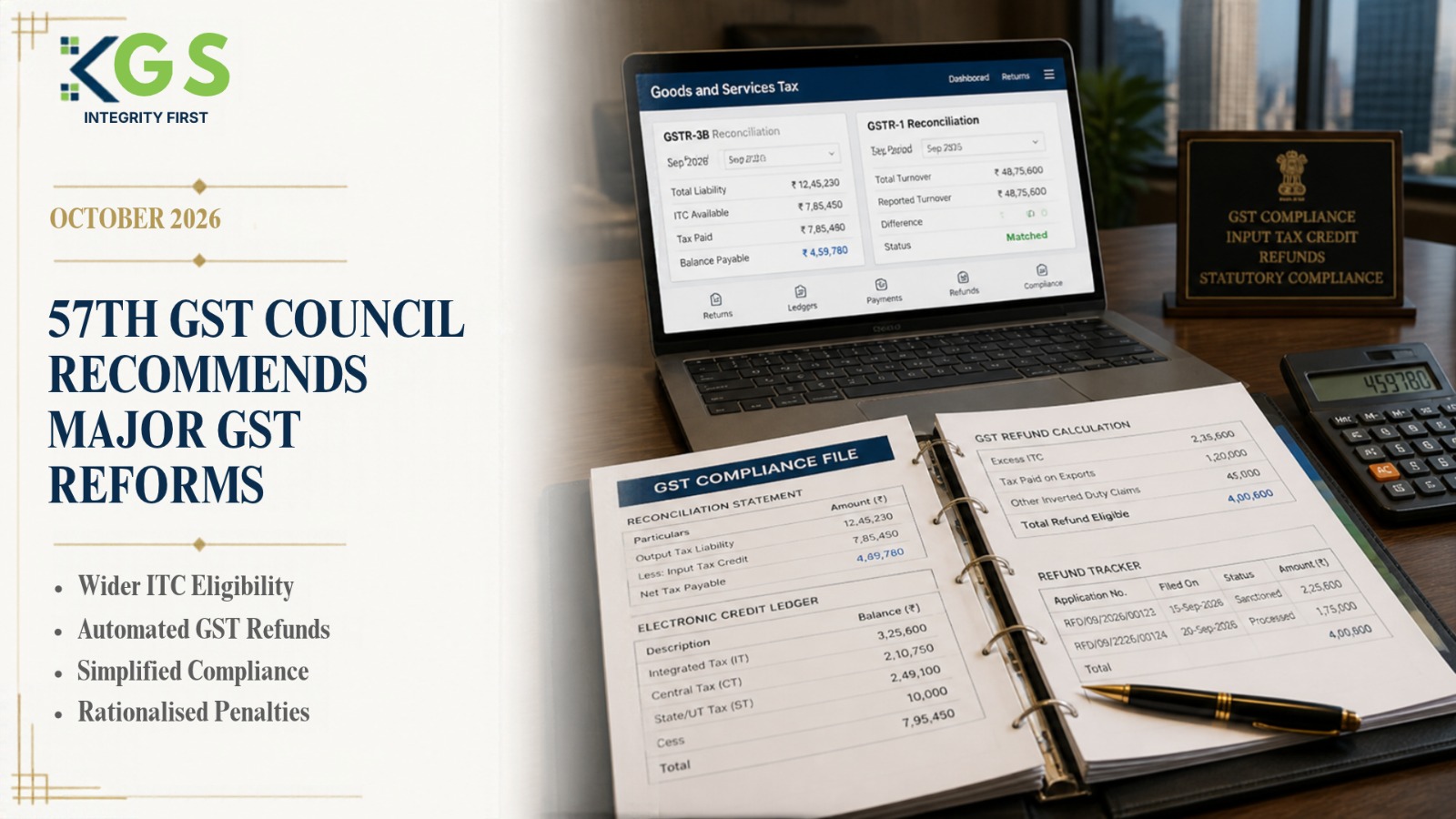
The 57th Meeting of the GST Council, held on 8 October 2026 under the chairpersonship of the Union Finance Minister, brought forward several significant recommendations aimed at simplifying GST compliance, improving ease of doing business and reducing litigation for taxpayers.
Unlike the previous meeting, which primarily focused on GST rate rationalisation, the 57th GST Council Meeting placed considerable emphasis on procedural reforms, input tax credit (ITC), refund mechanisms, registration procedures and rationalisation of demand and prosecution provisions.
The recommendations are expected to benefit businesses, exporters, small taxpayers and GST practitioners by reducing procedural complexities and promoting a more transparent and technology-driven GST administration.
Let us examine the major recommendations and their potential implications for taxpayers.
1. Simplification of GST Registration and Cancellation
The GST Council has recommended several measures to simplify the registration process and reduce unnecessary interaction between taxpayers and tax officers.
Key recommendations include:
- Introduction of comprehensive guidelines and FAQs specifying the documents required for GST registration.
- Improvements in Form GST REG-01 through prescribed document-selection options and a more user-friendly portal interface.
- Automatic acceptance of amendments to registration particulars, except changes relating to the Principal Place of Business, subject to specified exceptions for Rule 14A taxpayers.
- Phased introduction of automatic acceptance of cancellation applications after filing pending returns and payment of outstanding dues.
- Introduction of a simplified registration mechanism for eligible small sellers supplying goods through e-commerce operators in other States, subject to prescribed conditions.
Impact on taxpayers:- These measures are expected to reduce registration-related queries, delays and officer intervention, making GST registration and cancellation more efficient.
2. New Mechanism for GSTR-1, GSTR-3B and ITC Reconciliation
To minimise discrepancies between GST returns and reduce system-generated notices, the Council has recommended an alternative mechanism for correcting tax liability and ITC reporting.
The proposed changes include:
- Enhancements in GSTR-1, GSTR-1A and IFF.
- An electronic statement for reconciliation of reverse charge tax paid and corresponding ITC claimed.
- An Electronic Credit Reversal and Reclaim Statement to track ITC reversals and subsequent reclaims.
- Improvements to the Invoice Management System (IMS).
- A mechanism to correct liability and ITC reported in GSTR-3B so that they align with the relevant outward supply and ITC statements.
The revised mechanism is proposed to come into force from the April 2027 return period, subject to consultation and finalisation.
Impact on taxpayers:-Businesses will need to strengthen monthly reconciliation procedures to ensure consistency between outward supplies, tax liability, ITC availability and ITC utilisation.
3. Faster and Automated GST Refund Processing
Recognising the importance of timely refunds for business cash flows, the Council has recommended a phased system-based refund mechanism.
Major recommendations include:
- Automatic sanction of eligible excess balance in the electronic cash ledger.
- Reduction of the acknowledgement or deficiency memo timeline from 15 days to 10 days.
- Automatic provisional sanction of 90% of eligible refund claims relating to zero-rated supplies and inverted duty structure, subject to system-based risk assessment.
- Automated sanction of full eligible refunds for specified zero-rated supplies under Phase 2, subject to verification and adjustment of pending dues.
- Simplification of Form GST RFD-01 through system-readable information.
- Removal of the restriction limiting zero-rated goods turnover to 1.5 times the value of like goods domestically supplied under Rule 89(4)(C).
Impact on taxpayers:- The proposed reforms aim to reduce manual processing, improve refund timelines and ease working capital constraints, particularly for exporters and businesses facing inverted duty structures.
4. Wider Availability of Input Tax Credit
One of the most significant recommendations concerns the rationalisation of blocked ITC under Section 17(5) of the CGST Act, 2017.
The Council has recommended removing restrictions on ITC relating to specified supplies, including:
- Outdoor catering.
- Health and life insurance.
- Life insurance.
- Telecommunication towers.
- Pipelines laid outside factory premises.
- Free samples.
- Goods destroyed or written off on expiry of shelf life as required by law.
Additionally, the Council has recommended allowing refunds of accumulated ITC on:
- Capital goods in cases involving zero-rated supplies.
- Input services and capital goods in cases involving inverted duty structure.
The proposed applicability dates are:
- Input services for inverted duty structure refunds: ITC availed on or after 1 November 2026.
- Capital goods for zero-rated and inverted duty structure refunds: ITC availed on or after 1 April 2027, with refunds spread over 60 months.
Impact on taxpayers:- These recommendations are expected to reduce the accumulation of blocked credits and improve the availability of working capital, subject to the final legislative amendments and prescribed conditions.
5. Rationalisation of GST Demand, Penalty and Prosecution Provisions
The Council has recommended important changes to reduce unnecessary litigation and rationalise the consequences of GST non-compliance.
Provision and the recommendations
Sections 73, 74 and 74A - Minimum threshold of ?10,000 for issuance of show cause notices.
Section 73 - Reduced penalty of 5% in specified non-fraud cases if tax and interest are paid within 30 days of the adjudication order.
Section 74A - Reduced penalty of 5% in specified non-fraud cases if tax and interest are paid within 60 days of the adjudication order.
Section 125 - Reduction in maximum general penalty from ?25,000 to ?10,000.
Sections 107(6) and 112(8) -Maximum pre-deposit cap of ?40 crore for appeals involving only penalty and no tax demand.
The Council has also recommended:
- Complete withdrawal of arrest powers under Section 69 of the CGST Act.
- Increasing the monetary threshold for prosecution from ?1 crore to ?5 crore.
- Rationalisation of offences and punishments under Section 132.
Impact on taxpayers:- These measures aim to provide greater certainty, reduce the financial burden of litigation and establish a more proportionate approach to GST enforcement.
6. Rationalisation of E-Way Bill Interception and Detention
To facilitate smoother transportation of goods, the Council has recommended changes to Sections 68, 129 and 130 of the CGST Act.
The proposed measures include:
- Interception of vehicles only on the basis of specific intelligence and authorisation by an officer not below the rank of Joint Commissioner.
- Restrictions on inspection and detention proceedings in transit States, subject to specified exceptions.
- Continued power to inspect or detain goods where an e-way bill or prescribed documents showing the origin or destination of goods are unavailable.
- Non-applicability of confiscation provisions under Section 130 to goods and conveyances in transit.
Impact on businesses:- These recommendations are expected to reduce unnecessary interruptions during transportation and improve logistics efficiency.
7. Relief for Small Taxpayers
The Council has recommended certain measures specifically aimed at reducing compliance costs for small businesses.
These include:
- Waiver of late fees for delayed returns under Section 39(1) for eligible taxpayers having preceding-year turnover up to ?5 crore, provided the delayed return is filed by the end of the month in which it was due.
- In-principle approval of an optional Annual Return Quarterly Payment (ARQP) scheme for eligible B2C taxpayers with preceding-year aggregate turnover up to ?5 crore.
- Simplified GST registration for eligible small e-commerce sellers.
These measures are expected to ease compliance requirements for smaller businesses and improve voluntary compliance.
8. Measures to Facilitate Export of Services
The Council has recommended amendments to the IGST Act, 2017, to facilitate exports of services from India.
The key recommendations include:
- Removal of the distinct-person condition under the definition of export of services in specified circumstances.
- Clarification regarding receipt of export consideration in foreign exchange or Indian rupees wherever permitted.
- Changes to the place-of-supply provisions for specified services involving goods made physically available by the recipient.
- Clarification regarding certain supplies to overseas buyers involving delivery in SEZs or FTWZs.
Impact on taxpayers:-These measures are expected to provide greater clarity and facilitate access to export-related benefits for eligible Indian service providers and businesses.
9. Other Important GST Clarifications and Recommendations
Apart from the above reforms, the Council has also recommended several changes and clarifications concerning specific goods and services.
Some notable recommendations include:
- Uniform treatment of temporary and permanent transfer of title in Intellectual Property Rights as supply of services.
- Opportunity for taxpayers to submit objections and obtain a personal hearing before a decision on blocking ITC under Rule 86A.
- Clarification regarding ITC eligibility for demonstration vehicles in specified situations.
- Clarification regarding ITC distribution under the Input Service Distributor mechanism.
- Extension of e-invoicing to specified domestic reverse charge supplies received from unregistered persons and imports of services for taxpayers having aggregate annual turnover of ?5 crore or more.
- Clarifications regarding GST treatment of specified goods, agricultural services, passenger transport and other notified services.
Conclusion
The recommendations of the 57th GST Council Meeting represent an important step towards simplifying GST administration and improving the overall compliance environment.
The focus on automated refunds, improved ITC reconciliation, rationalisation of penalties, simplification of registration and reduction of unnecessary litigation reflects an approach aimed at making GST administration more transparent, efficient and taxpayer-friendly.
Businesses should review the proposed changes, assess their potential impact on existing compliance procedures and prepare for the implementation of the relevant reforms.
Important Note:- The above changes represent recommendations of the 57th GST Council Meeting held on 8 October 2026. They should not be treated as effective statutory amendments merely on the basis of the press release. Their applicability will depend on the relevant notifications, circulars, rules and legislative amendments issued by the competent authorities.
*Source: Ministry of Finance – Recommendations of the 57th Meeting of the GST Council, dated 8 October 2026.*

Comments
No Comments yet