EXECUTIVE SUMMARY
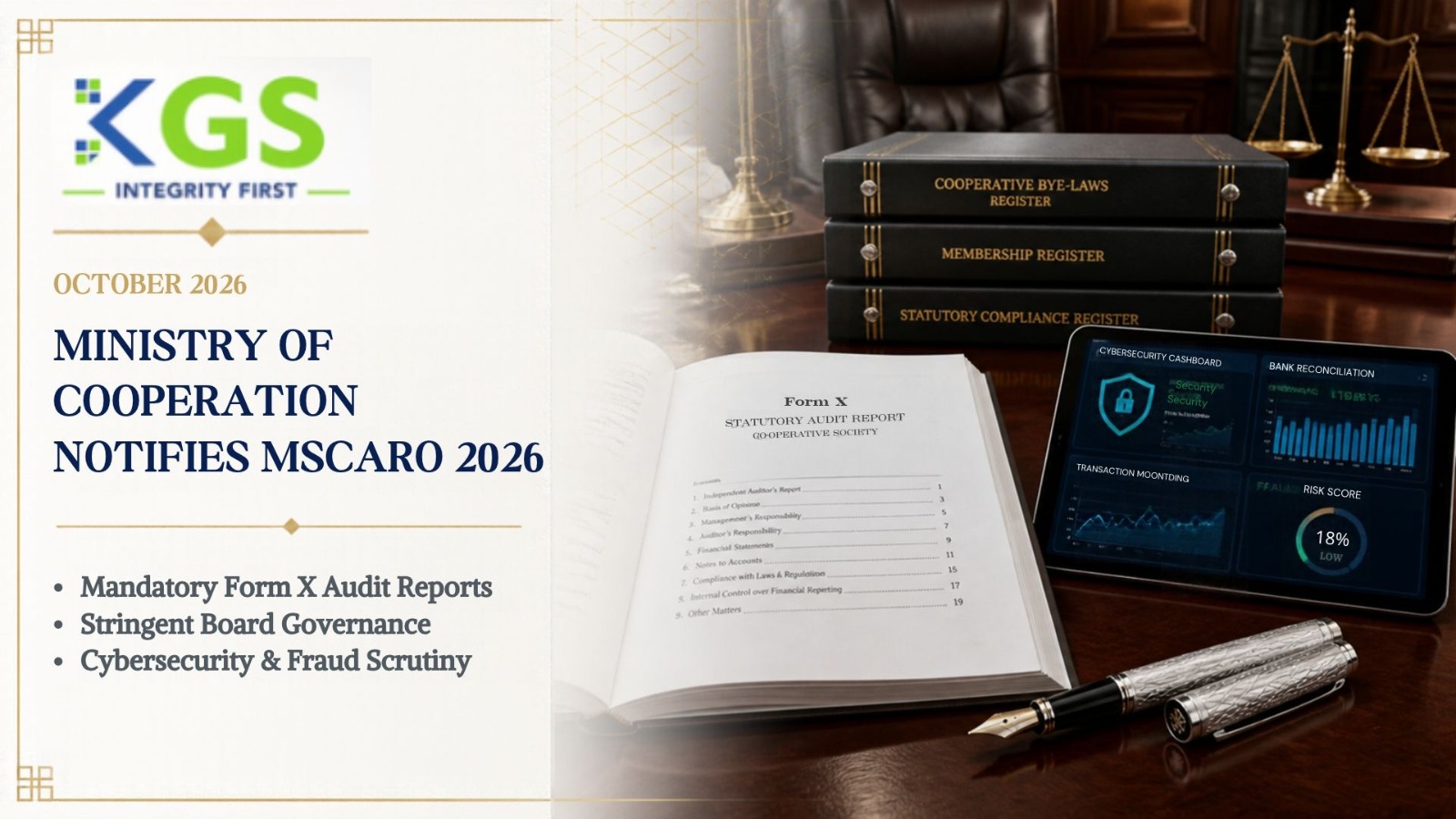
The Ministry of Cooperation has officially issued the Multi-State Co-operative Societies (Auditor's Report) Order, 2026 (MSCARO, 2026) under Section 73(6) of the Multi-State Co-operative Societies Act, 2002.
Issued in October 2026, this landmark order fundamentally shifts the regulatory and compliance landscape for applicable co-operative societies. Qualifying societies are now mandated to furnish an auditor-verified report in the newly appended Form X alongside their annual financial statements, enforcing corporate-grade governance, stringent asset management, and robust fraud prevention frameworks.
BACKGROUND
Historically, the audit of multi-state co-operative societies focused primarily on basic financial reconciliation. However, as the financial footprint and operational complexity of these societies have grown to rival commercial entities, the Ministry of Cooperation identified an urgent need to standardize boardroom discipline, internal controls, and cybersecurity.
MSCARO 2026 bridges this regulatory gap by introducing a comprehensive auditor-reporting framework akin to CARO for corporate entities, ensuring that member funds are safeguarded through heightened transparency and strict statutory oversight.
WHAT HAS CHANGED
• Audit Reporting Format
Earlier: Standard cooperative audit reports.
Revised: Mandatory structured reporting in the new Form X.
• Governance Scrutiny
Earlier: Limited regulatory reporting on boardroom composition.
Revised: Strict auditor verification of SC/ST, women, and co-opted director representation under Section 41.
• Concurrent Audit
Earlier: Subject to internal bylaws.
Revised: Mandatory for societies with turnover/deposits > 500 crore using a CRCS-approved auditor.
KEY PROVISIONS
Boardroom Discipline & Committees:
Auditors must explicitly verify compliance with Section 41 regarding director representation (SC/ST, women, co-opted). Societies must conduct valid quarterly board meetings, hold their Annual General Meeting (AGM) within six months of the year-end, and maintain active Audit, Ethics, and Prevention of Sexual Harassment (POSH) committees.
Asset & Inventory Management:
The order mandates proper maintenance of Property, Plant, and Equipment (PPE) records and title deeds. Asset revaluations exceeding a 10% change must be reported, and inventory requires regular physical verification.
*Financial Health & Banking:
Working capital limits over ?50 lakh demand strict reconciliation with bank statements. Furthermore, strict adherence to loan documentation, collateral monitoring, and NPA provisioning is now mandatory.
Statutory Fund Transfers & Prohibitions:
Mandatory profit transfers must be executed to the General Reserve and Co-operative Education Fund (CEF) or CRRDF. Direct or indirect political contributions from society funds are strictly prohibited.
Cybersecurity & Fraud Reporting:
Auditors must explicitly report any discovered frauds, including the duration, amount, and responsible individuals. Robust cybersecurity policies (firewalls, backups, access controls) are mandatory, alongside the reporting of system breaches.
Ombudsman & AML Compliance:
Societies must appoint a Co-operative Information Officer (CIO) to handle member requests within 30 days. Entities reporting to FIU-IND must appoint a Principal Officer, file Suspicious Transaction Reports (STRs), and maintain rigorous anti-money laundering measures.
APPLICABILITY
The reporting framework is implemented in a phased manner based on the cooperative's financial footprint:
Phase 1 (Financial Year 2027-28):
Applies to societies that, in FY 2026-27, had gross receipts, aggregate deposits and borrowings, or loans and advances exceeding ?1,000 crore at any time during the year.
Phase 2 (Financial Year 2028-29 onwards):
The threshold expands significantly to cover societies with preceding-year gross receipts or deposits/borrowings exceeding ?50 crore, or loans and advances exceeding ?250 crore.
PRACTICAL IMPLICATIONS
• Compliance & Audit Burden: The depth of Form X requires auditors to shift from pure financial vouching to evaluating operational governance, IT infrastructure, and statutory compliance, significantly increasing the time and cost of annual audits.
• IT System Overhauls: The mandate for robust cybersecurity policies and data loss incident reporting will force many traditional cooperative societies to aggressively upgrade their digital infrastructure and data protection mechanisms.
• Governance Restructuring:b Boards must immediately review their composition and committee structures to prevent auditors from issuing qualified reports regarding director disqualifications or missing diversity mandates.
WHAT SHOULD WE DO
• Conduct a Gap Analysis: Management should immediately assess their current financial thresholds against the Phase 1 and Phase 2 applicability criteria to determine their effective compliance date.
• Establish Mandated Committees: Formally constitute the required Audit, Ethics, and POSH committees, ensuring their charters and meeting frequencies align with the new statutory expectations.
• Upgrade Record Keeping: Finance teams must reconcile all PPE records, title deeds, and working capital limits exceeding ?50 lakh with active bank statements to ensure audit readiness for Form X.
• Implement Cybersecurity Protocols: IT departments must deploy verifiable firewalls, access controls, and regular data backup routines to satisfy the digital compliance requirements of the new order.
KGS PERSPECTIVE
MSCARO 2026 represents a watershed moment for the cooperative sector, signaling the Ministry's zero-tolerance approach toward governance lapses and financial opacity.
By intertwining anti-money laundering protocols, cybersecurity mandates, and stringent asset verification into the auditor's report, the government is effectively demanding corporate-level compliance from multi-state co-operatives.
Management committees must treat Form X not merely as an annual checklist, but as a blueprint for institutional reform. Failing to establish the required internal controls now will inevitably lead to adverse audit remarks, severe regulatory scrutiny, and a loss of member trust.
SOURCE / REGULATORY REFERENCE
Regulator:Ministry of Cooperation
Notification : Multi-State Co-operative Societies (Auditor's Report) Order, 2026 (MSCARO, 2026) [Issued October 2026]
Official Document Link:
https://www.cooperation.gov.in

Comments
No Comments yet